
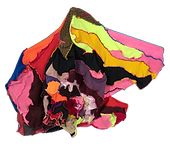

hloë Hugo-Hamman is an artist and teacher who lives and works in Cape Town. She works across drawing, textiles and sculpture. Her work gives form to psychological worlds that are difficult to put into words.
Using colour, repeated marks and hand-stitched textiles, she explores how inner experience is shaped by social and cultural structures. In doing so, she creates space to question existing systems and consider different ways of seeing and experiencing the world.
Her work has been exhibited at Whatiftheworld in Cape Town, FNB Art Joburg and Supermarket Art Fair in Stockholm. She holds a Bachelor of Architectural Studies from the University of Cape Town, a Master of Fine Art from the University of the Witwatersrand, and a Postgraduate Certificate in Education from the University of Cape Town.
%20Chlo%C3%AB%20Hugo-Hamman%20-1_edited.png)



C


%20Chlo%C3%AB%20H.png)


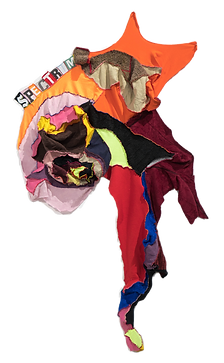
A Womxn's Dis-ease 2018
The Point of Order (TPO)
Johannesburg
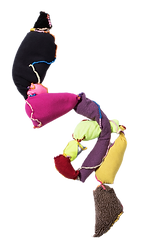
A Womxn’s Dis-ease picks-apart, layers, sutures and sews. It is an unfinished, radically vulnerable, fragmented, always-in-process, personal narrative of chronic illness, that works towards depathologising what the Western medical-industrial complex refers to as ‘mental illness.’ It is a layered palimpsest that labours towards crafting communities of care, through the reframing of ‘disease’ as dis-ease within the neoliberal, white supremacist, imperial-capitalist, cisheteropatriarchy.
Colour bleeds into material, fabric bloats and twists into organic forms that extend the boundaries of the body and delink being-in-the-world from reductive categorisations of personhood. A Womxn’s Dis-ease deconstructs and disrupts processes of labelling and the ways in which language is embedded within patriarchal structures of power.
I, like many other feminists, chose the convention of writing womxn with an ‘x’ as a strategy of disentangling ‘woman’ or ‘women’ from the subject-position of ‘man’ or ‘men’. The decision to hold ‘womxn’ within the title of this work is also a deliberate one, which resonates with Johanna Hedva’s Sick Woman Theory. As they explain in ‘My Body is a Prison of Pain So I Want to Leave it Like a Mystic But I Also Love It & Want it to Matter Politically’ (2015);
“To take the term ‘woman’ as the subject-position of this work is a strategic, all-encompassing embrace. Though the identity of ‘woman’ has erased and excluded many, especially women of color and trans and genderfluid people, I choose to use it because it still represents the uncared for, the secondary, the particular rather than the universal. The problematics of this terms will always require critique, and I hope that Sick Woman Theory can help undo those in its own way.”
A Womxn’s Dis-ease holds space for tension and ambiguity, it undoes and interweaves, embracing Sara Ahmed’s idea of feminism as “tear in the social fabric” (2017). It’s about “falling apart at the seams” and “putting yourself back together” (2017).
It’s about radical kinship and reimaging and reinhabiting the body through emotional affect and the realization that;
“Feeling bad might in fact, be the ground for transformation” (Cvetkovich).
References
Hedva, Johanna. 2015. My Body is a Prison of Pain So I Want to Leave it Like a Mystic But I Also Love It & Want it to Matter Politically. Lecture. Los Angeles: Human Resources, October 7, 2015.
Ahmed, Sara. 2017. Living a Feminist Life. Durham: Duke University Press.
Cvetkovich, Ann. 2012. Depression: A Public Feeling. Duke University Press. Kindle Edition.
